- On foot: Ten minutes west
- Getting there: Ten minutes west of Market Square on foot
The walk from Market Square crosses a short hill. The park has little shade at midday in summer, so go early or late.
World's Fair Park sits in a shallow valley on the western side of downtown Knoxville, between the business district and the university. The valley was once a rail yard and an untidy stretch of industrial land along Second Creek. In 1982 it became the grounds of an international exposition, and much of it is now a public park with lawns, water features and a handful of buildings left from the fair.
The 1982 fair
The Knoxville International Energy Exposition ran from spring to autumn in 1982, with energy as its theme. It was a sanctioned world's fair, and a small city surprised many people by pulling it off: national pavilions, exhibits and entertainment drew millions of visitors over six months. When it closed, most of the temporary pavilions were removed, and the site went through a long period of uncertain use before being developed as a park.
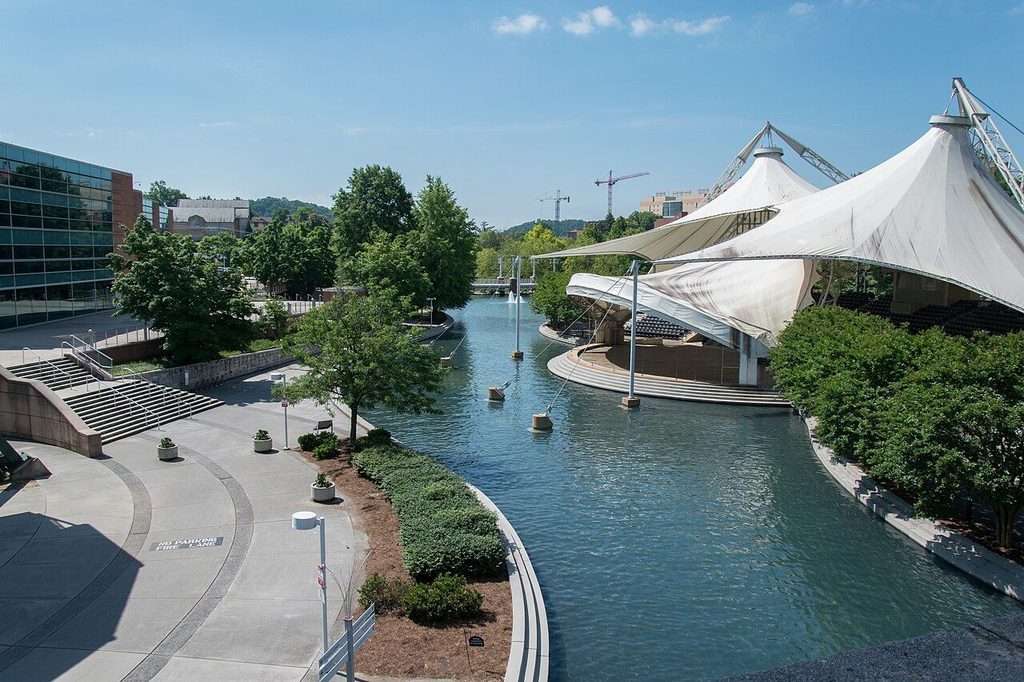
A few pieces of the fair survive. The most obvious is the Sunsphere. The other is the large tented amphitheater beside the water, which has been restored and is used for concerts and events.
The Sunsphere
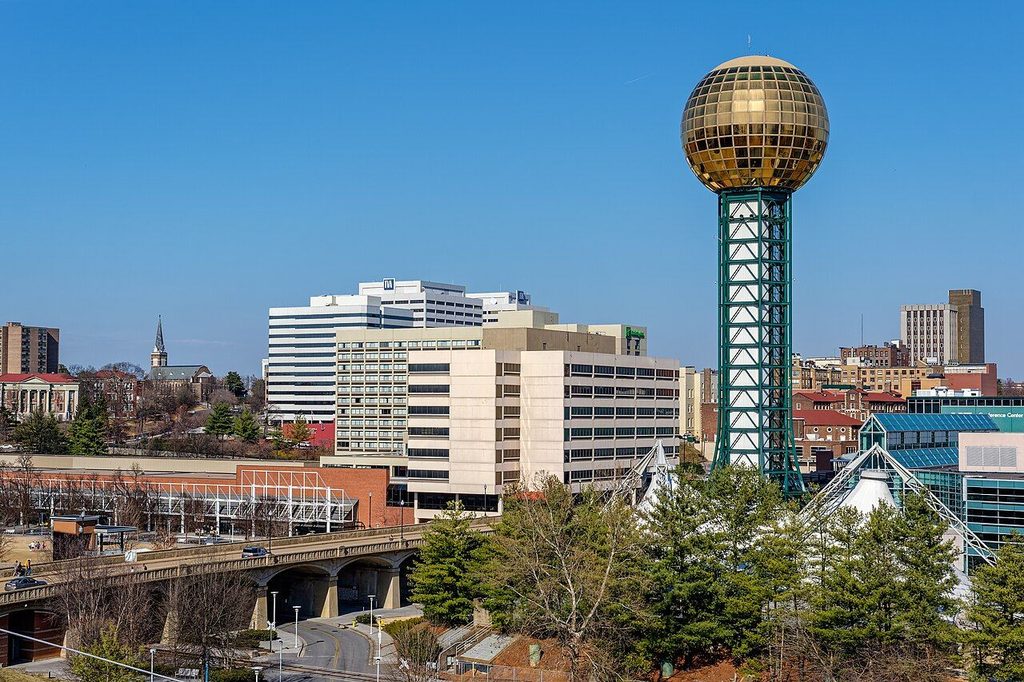
The Sunsphere is a steel lattice tower, painted green, topped with a sphere of gold-tinted glass. It was built as the symbol of the fair and is about 266 feet tall. For years after 1982 it was little used, and it had a reputation as a slightly odd leftover. It is now one of the best-known shapes on the Knoxville skyline.
An elevator runs to an observation level inside the sphere, which gives a view over downtown, the university, the river and, on a clear day, the line of the mountains to the south-east.
Walk on to The river and the urban wilderness
Walking the park
The park is long and narrow, following the old creek. Start at the southern end near the amphitheater and walk north along the water channel, which has pools, small falls and a fountain area where children play in summer. The lawns open out further up the valley and are used for festivals and larger outdoor events.
The amphitheater is easiest to appreciate from the paths above it, where you can see the white fabric roof stretched over its masts. When it is not in use you can usually walk around its edges and look across the water at the stage.
At the park's edge stands the Knoxville Museum of Art, a building faced in pink Tennessee marble, which holds regional and contemporary collections.
Other buildings around the park have their own fair history. A few older brick structures that predate 1982 were kept and reused, and the large convention centre on the eastern side was built later on part of the old grounds. Plaques and markers here and there recall what stood where, though there is no single museum of the fair; the small exhibits that have existed in the area come and go.
A full loop of the park, with a pause at the Sunsphere and the amphitheater, takes about an hour at an easy pace.
Routes to Knoxville
From Market Square, the walk west takes around ten minutes. The route crosses a short rise before dropping into the park, so allow a little extra effort on a hot day. There is parking around the park, but large events fill it quickly.
The park ties in well with other walks. You can go back to the centre by a different street and finish on Gay Street, or head south toward the river and the riverside path. If you have a car and a clear day, the view from the Sunsphere is a fair preview of a day in the Smokies, whose ridges show on the horizon.
The good months at Knoxville
Spring and autumn are the most comfortable seasons. Summer days in the valley can be hot and humid, and the paved paths reflect the heat, so mornings and evenings are better. On festival weekends the park is crowded and some areas may be fenced; on an ordinary weekday it is quiet and open.
Bring: Water, a hat, sun cream